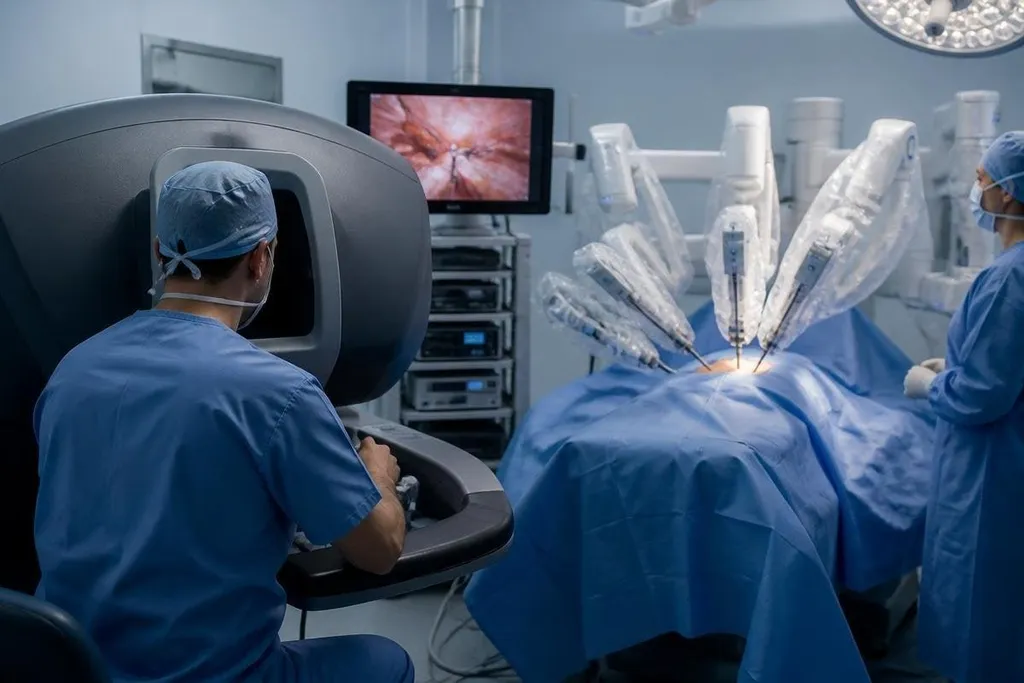
Surgical robots are moving beyond remote-controlled instruments. Progress will come from better control, clearer views inside the body, and software that helps a surgeon avoid avoidable errors.
This matters if you work in a hospital, compare medical automation products, or want to understand which claims deserve attention.
Quick read
- Robotic arms still need a surgeon for most decisions and actions.
- Better imaging may matter more than adding another joint to the arm.
- The hardest test is safe use across many procedures, surgeons, and hospitals.
Better control at the operating table
Most surgical robots use teleoperation. The surgeon moves hand controls, and the system moves small instruments inside the patient. The robot can filter hand tremor, scale motion, and hold an instrument steady while the surgeon works.
Software will then need to respond to the task without taking control away. A system might limit movement near a marked vessel, slow an instrument near delicate tissue, or warn when the tool is outside the planned path.
Those functions need clear rules, since a warning that arrives late can add work instead of reducing it.
Partial automation will be harder. A robot may hold tissue under steady tension while the surgeon cuts, or move a camera to keep the work area visible. The software must know when the scene has changed and give control back without delay.
That last part is where many claims need careful reading. A short demonstration can show that a robot repeats one motion. It doesn't show how the system handles bleeding, blocked views, unusual anatomy, or a tool that slips.
Imaging that gives the surgeon more useful information
A camera image is only one part of the operating view. Future systems may combine normal video with data from ultrasound, fluorescence, force sensors, or preoperative scans. Each source can add information that the eye cannot get from a flat image alone.
The hard problem is timing. If the image overlay shifts as tissue moves, the surgeon may see a neat graphic in the wrong place. Software must track motion, show uncertainty, and keep the display from covering the real tissue that matters.
Force sensing could help with another blind spot. A surgeon operating through long instruments may not feel tissue in the same way as they would with an open procedure. Sensors at the instrument tip could record pressure or contact, then send that information to the hand controls or screen.
Pressure data helps only when the surgeon can use it without slowing the procedure. Reports at Robot24 can place a named surgical system, procedure, test setting, and evidence beside those claims before the article turns to smaller tools and wider access.
Smaller systems and wider access
Large robotic systems can need a dedicated room layout, trained staff, and a service plan. Smaller arms, modular instruments, and portable imaging could make robotic tools easier to place in more operating rooms.
Size alone won't decide the result. A lighter system still needs accurate positioning, sterile covers, reliable instrument changes, and a clear method for cleaning and maintenance. Hospitals will also ask how long setup takes and what happens when a part fails during a case.
Cost belongs in the same discussion. A hospital needs to count the robot, instruments, service, training, room changes, and staff time. A lower purchase price can lose its value if disposable tools cost more or the system keeps a room unused during setup.
The strongest products will fit the full procedure, not one isolated movement. That includes planning, patient positioning, tool changes, imaging, records, and recovery data.
What still needs proof
The medical value of a surgical robot cannot be judged from arm speed or the number of joints. It needs results from real procedures, with clear measures such as complication rates, operating time, recovery, and repeat surgery.
Training data also matters for software that suggests motions or marks tissue. The system needs tests across different bodies, conditions, and surgical styles. A model that works in one hospital may need more work before another hospital can use it safely.
Hospitals should ask for failure records, not only successful cases. They need to know how often the robot stops, how fast staff can switch to manual tools, and which tasks still require direct surgeon control.
A practical buying checklist
Use these questions before giving a surgical robot a place in your hospital plan:
- Procedure fit: Which named procedure does it improve, and by how much?
- Clinical proof: Are the results from real patients, with a clear comparison group?
- Failure response: Can the team finish the case if the robot or software stops?
- Room demand: What space, power, network, staff, and cleaning steps does it need?
- Five-year cost: Include service, training, instruments, upgrades, and downtime.
- Data control: Who stores the procedure data, and who can review it after a failure?
A useful test is simple: can a system help during a difficult case while making its limits plain to the surgeon? Until vendors publish that evidence across real procedures, the safest bet is better assistance with human control kept in the loop.